WELCOME TO THE ARCHIVE (1994-2014) OF THE MAQUILA SOLIDARITY NETWORK. For current information on our ongoing work on the living wage, women's labour rights, freedom of association, corporate accountability and Bangladesh fire and safety, please visit our new website, launched in October, 2015: www.maquilasolidarity.org
LAST UPDATED: APRIL 2007
With the exception of a few alternative trading companies that market clothing manufactured in worker-owned cooperatives or unionized factories as ‘sweatfree' or ‘Union Made', to date there have been only minimal efforts to create alternative niche markets for fair trade apparel products.
All of that could change with the emergence of a number of new initiatives in North America and Europe in which fair trade and/or labour rights organizations are moving toward the certification of apparel products as ‘fair trade' or ‘sweatfree'.
But ‘Sweat-free' initiatives raise numerous questions: What criteria should be employed to determine ‘sweat-free?' How is production monitored to be certain that ‘sweat-free' standards are maintained? And should providing consumer choices figure prominently in activists' strategies anyway?
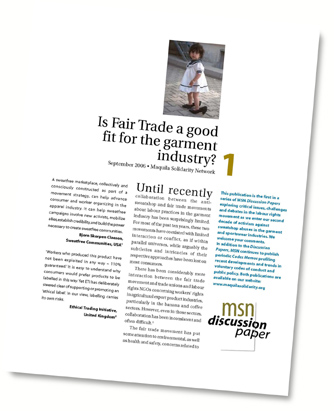 Can a ‘fair trade' apparel brand expand the fight for worker rights or would it reduce the pressure on mainstream apparel companies to change their labour practices? Would fair trade apparel brands finally give consumers an effective way to "vote with their dollars" or could they actually confuse and demobilize consumers? And what will it mean for worker organizing in the apparel industry?
Download the Discussion Paper here (PDF format, 500k)


Unless otherwise noted, all work on this website is licensed under a
Creative Commons Attribution-Noncommercial-Share Alike 2.5 Canada License.