WELCOME TO THE ARCHIVE (1994-2014) OF THE MAQUILA SOLIDARITY NETWORK. For current information on our ongoing work on the living wage, women's labour rights, freedom of association, corporate accountability and Bangladesh fire and safety, please visit our new website, launched in October, 2015: www.maquilasolidarity.org
When Gildan Activewear announced the closure of two of its factories in the State of Coahuila in northern Mexico last March, workers had reason to be worried. But after a series of discussions with MSN and the local labour rights organization SEDEPAC, Gildan has set a precedent for workers who are used to being denied even their legal entitlements.
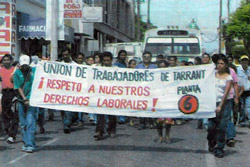 Given how important it is that the NAALC process focus on the larger issues that were raised in Public Communication #2003-01 (Puebla), a summary outlining the fundamental violations described by those who testified in both Washington and Toronto was presented to the Canadian NAO. According to this summary, the five central components of the Complaint, as illustrated by the testimony provided on May 28 in Toronto, are:
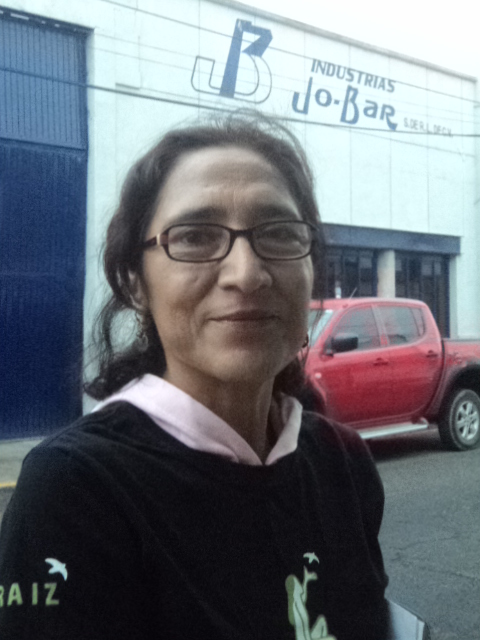
 After many setbacks, Colectivo Raiz, MSN's partner in Aguascalientes, Mexico, is making some progress toward remediation of long-standing worker rights violations at a Levi's supplier factory in that city, though a number of issues remain unresolved.
 The cost of an unpaid lunch break may not seem like much, but when you add up the lost income over a number of years, it represents a significant amount of money, particularly for a low-paid Mexican maquila worker.
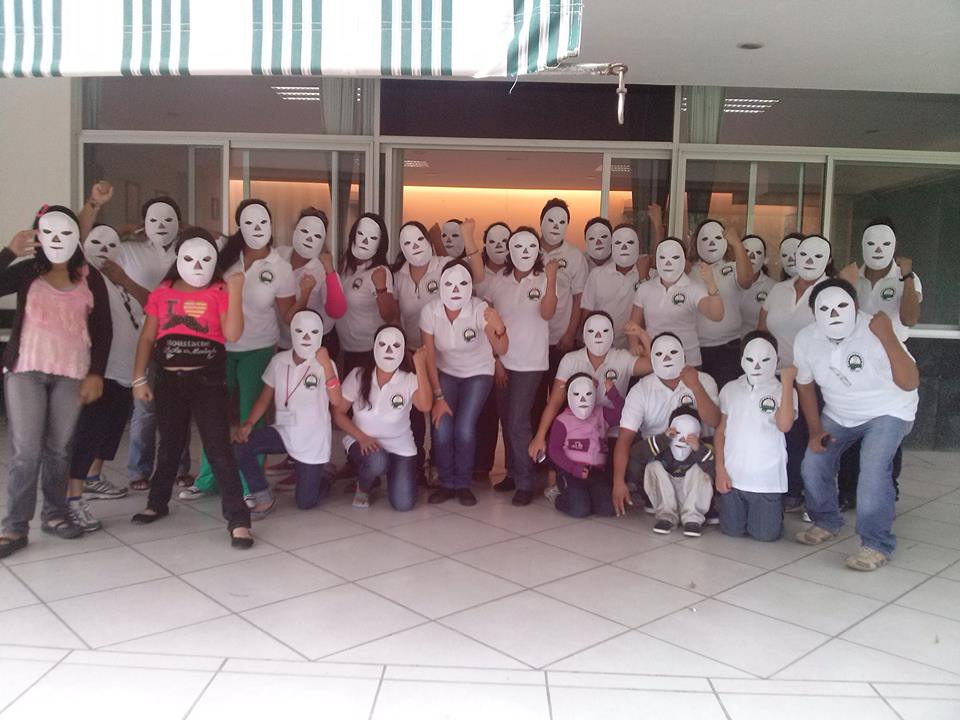 (Photo: CETIEN)
In August, the Centre for Reflection and Labour Action (CEREAL in Spanish)
in Guadalajara, Mexico released its 2012 report on labour issues and cases
of worker rights violations in the country's electronics manufacturing industry.
The report highlights the problem of employer protection contracts signed
between hundreds of electronics manufacturing firms and unelected
union leaders.
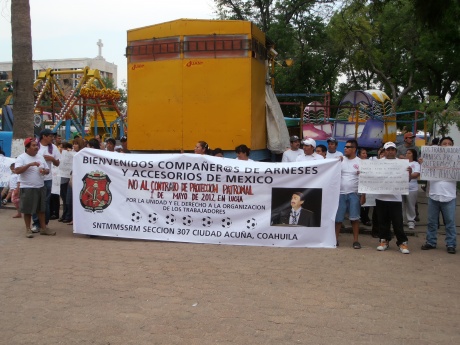 The Mexican National Miners’ Union (Los Mineros) is challenging the results of a union representation election at the Finnish-owned PKC auto parts factory in Ciudad Acuña, Mexico. According to the official count, Los Mineros narrowly lost the vote – 2,311 to 2,509 – to a “protection union” affiliated with the Confederation of Mexican Workers (CTM) that was supported by the employer.

Faced with ongoing harassment, physical assaults and death threats, MSN's long-time friends and allies at the Worker Support Centre (CAT) in Puebla, Mexico have been forced to close their office and suspend their support work with the state's maquiladora workers.
On May 15 at approximately 1:00 pm, four masked men in a van kidnapped worker rights defender José Enrique Morales Montaño, a member of the Worker Support Centre (CAT) in Puebla, Mexico. Morales was abducted as he was on his way to a hearing of at the Local Conciliation and Arbitration Board where the CAT was defending the rights of a group of garment workers.
 On January 30, 8,000 workers at the Arneses y Accesorios de México auto parts factory in Cuidad Acuña were informed by their employer that the company had signed a collective bargaining agreement with the Confederation of Mexican Workers (CTM), without their prior knowledge or consent.
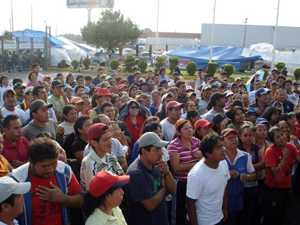 A long and dramatic struggle at the Johnson Controls Interiors (JCI) factory in Puebla, Mexico, has finally resulted in the expulsion of a sham "protection union" and the signing of a real collective bargaining agreement with Mexico's mineworkers' union (SNTMMSSRM or Los Mineros). The new JCI agreement, signed April 8, 2011, includes a 7.5% wage increase and better benefits for the 800 workers at the factory


Unless otherwise noted, all work on this website is licensed under a
Creative Commons Attribution-Noncommercial-Share Alike 2.5 Canada License.